An HTTP module in Make.com maps a remote API’s response into fields your scenario can use, and that mapping is built against the response shape the API returned the day you configured it. Nothing about Make enforces that the API keeps returning that same shape forever. When a connected service renames a field, moves a value one level deeper into a nested object, changes a number to a string, or adds pagination where there was none, the HTTP module still runs, still returns a response, and Make will still let you map from it, just not correctly if the mapping was built against the old shape. This is one of the quieter ways a working scenario stops working: nothing in your configuration changed, the API on the other end did.
Paste your Make logs and get a free analysis: analyze your logs free.
How the HTTP module hands you a response
The HTTP module’s job is to make the request and hand back what the remote server sent. Make’s documentation for the module describes a Parse response setting that, when enabled, structures the output data so that mappable items are available after you run the module once.
In practice, that means Make inspects the response the first time you run the module and offers you fields to map based on that response’s shape at that moment. Those mapped fields are pinned to that shape, by key name and by nesting level, not re-derived automatically on every future run. If the API changes what it returns after that point, the module keeps requesting and receiving data, but the fields you mapped may now point at something that no longer exists, or that has moved.
What actually breaks when the response shape shifts
A handful of shape changes account for most of these breaks. A renamed field means the key your mapping points to is gone from the new response, so the mapped value is empty even though the underlying data is still there under a new name.
A field moved one level deeper into a nested object means the same thing from a different cause, the value exists but your mapping is no longer pointed at the right path to reach it. A type change, a field that used to return a number now returning that same value as a string, can pass through Make without an error and then behave unexpectedly in a module downstream that expected a number, a filter comparison that stops matching, a calculation that produces nothing. And an API that introduces pagination where it previously returned everything in one response means your scenario is now only seeing the first page, with the remaining records simply never arriving, no error thrown anywhere in the chain.
Why does none of this throw a module error?
This is the part that makes response-shape drift hard to catch: every one of these changes lets the HTTP module complete successfully, because the module’s job is only to make the request and receive whatever response comes back, not to validate that the response matches what you originally mapped.
A missing field just becomes an empty value passed downstream. A moved field is invisible unless you go looking for it in the raw response. A silently paginated response looks, from the scenario’s outside, exactly like a normal successful run that happened to process fewer records than expected. The scenario’s status tells you the request succeeded; it does not tell you whether the shape of what came back still matches what your mapping assumes.
How do you read the actual response for a specific run?
The fix starts with looking at the raw response Make actually received on a run you suspect is affected, not the shape you remember configuring the mapping against. Open that run in the scenario’s history and check the output bundles of a specific module from that scenario run for the HTTP module itself.
The bundle shown there is the actual response structure for that run, field names, nesting, and types included, and comparing it directly against the fields your downstream mapping expects will usually show the mismatch immediately: a field you are mapping from is absent, or a field that used to be a top-level key is now nested under a new parent key.
Which downstream symptoms point back to a shape change?
A response-shape change often shows up first as a symptom somewhere else in the scenario rather than at the HTTP module itself. An Iterator that used to split a response’s array into several bundles and now produces none is a strong sign the array it depends on moved or was renamed in the response, since the Iterator only converts whatever array it is handed and cannot recover a value it can no longer find.
A filter that used to pass records and now blocks all of them can mean the field it checks moved or changed type. A field arriving blank in a downstream app is consistent with a renamed source field. In every one of these cases, tracing the symptom back to the HTTP module’s actual response for that run, rather than assuming the module downstream is at fault, is what actually finds the cause.
Which checks confirm a suspected shape change?
Run the same sequence whenever an HTTP-fed scenario starts producing empty or wrong values without any error. First, open the specific affected run and read the HTTP module’s raw output bundle for that run, not a fresh test call, since the API’s behavior may vary by request.
Second, compare that response’s field names, nesting, and types directly against what your downstream mapping expects, field by field. Third, check specifically for pagination, a response that now returns a subset with a cursor or page token where it previously returned everything at once. Fourth, if a downstream Iterator, filter, or field looks affected, trace it back to the HTTP module rather than assuming the downstream module is the source. Fifth, once the exact change is identified, decide whether the fix is remapping to the new field location or rebuilding the mapping to handle both shapes if the API is inconsistent.
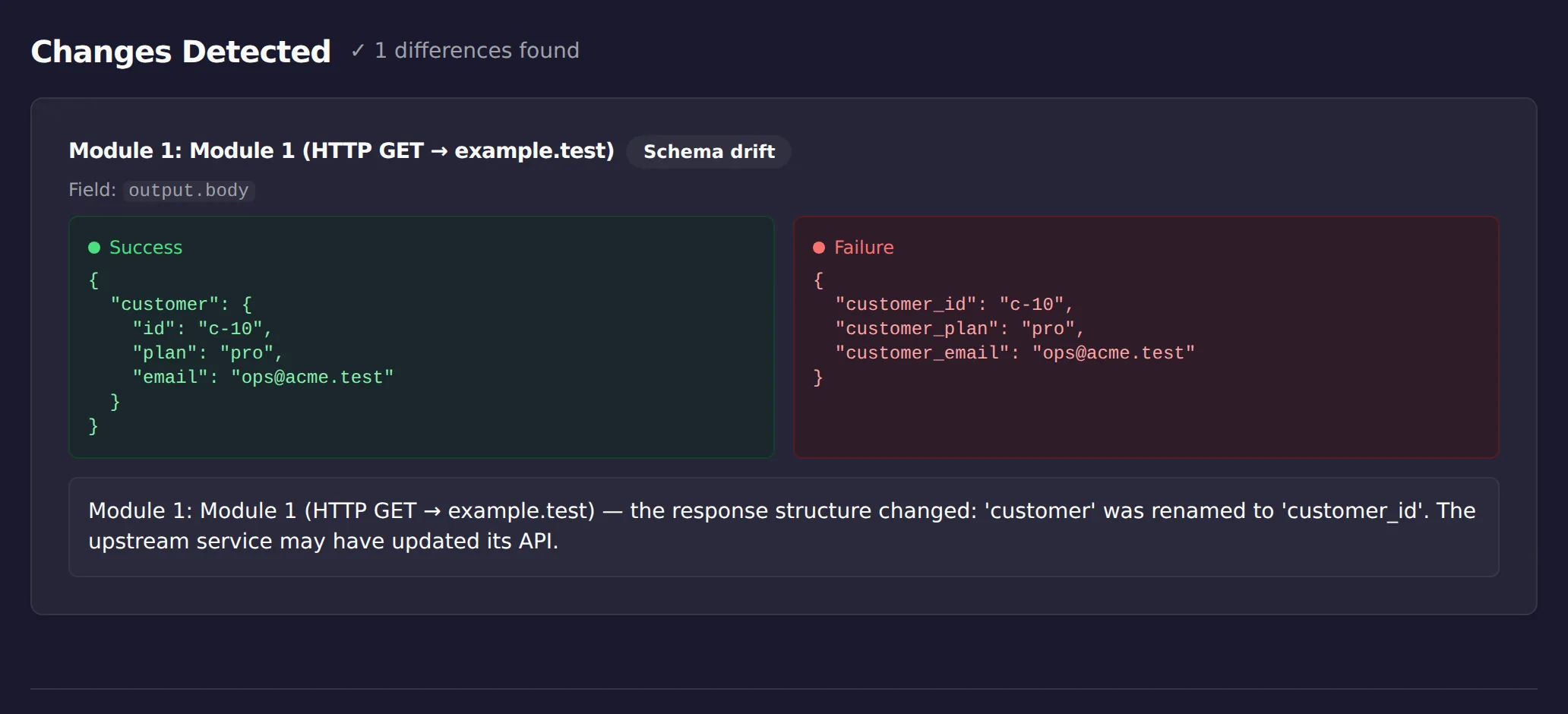
Shape changes are tedious to diff by hand precisely because everything still looks like JSON. In the screenshot above, ScenarioTrace’s free analyzer did the diff on this article’s example: the nested customer object gone, flat renamed keys in its place, every missing field listed, both runs green the whole time. Paste your own before-and-after output and you get the same list for your scenario; re-pinning the mappings to the new shape is still hand work, but at least it starts from a complete list.
How does the Parse response setting change what you can see?
The HTTP module’s Parse response setting is not automatic; it is a choice you make when configuring the module, and it changes what the module hands you. With it enabled, the output is structured so that mappable items become available after the module has run once, which is what lets you pick specific fields for downstream mapping in the first place.
Without it, the module still makes the request and still returns a response, but you are working with a less structured result rather than individually mappable fields, which makes a shape change harder to notice because there is no field-level mapping to visibly break, just a downstream module that now receives something it cannot use the way it did before. If a scenario that used to map specific fields from an HTTP response now behaves as if those fields do not exist, confirming that Parse response is still enabled, and still matches the response’s current shape, is worth checking before assuming the API itself is the source of the change.
Are authentication and method changes shape changes too?
A response’s structure is not the only thing that can shift under a mapping. Make’s HTTP module supports a range of authentication types, from no authentication through API keys and basic auth to OAuth 2.0, and a range of methods beyond a plain GET.
If a connected service changes what authentication it requires, rotates a credential format, or starts expecting a different HTTP method for the same operation, the request itself can start failing or behaving differently well before the response body’s shape is ever in question. When a scenario built around an HTTP module stops working cleanly, it is worth confirming the request side, authentication still valid, method still correct, alongside the response side, since both are configured independently and either one drifting produces a scenario that no longer does what it used to.
Which downstream symptom points at a shape change?
| Downstream symptom | What changed in the response | Where to look |
|---|---|---|
| A mapped field is suddenly empty | The field moved or was renamed | Read the raw response for one specific run |
| A value arrives as text instead of a number | The type changed | Compare the bundle against an older successful run |
| A loop processes the wrong number of items | An array became an object, or nested one level deeper | Inspect the array the iterator receives |
| Nothing errors but results are wrong | None of these throw a module error | The run history, not the error log |
Limitations
This is a manual comparison of a specific run’s actual response against your existing mapping; it does not automatically detect when a connected API changes its response shape, and it will not alert you before a change causes a downstream problem.
It does not fix the mapping for you, and it depends on you having a specific run to inspect, ideally one from soon after the symptom first appeared. It is not a substitute for monitoring an integration you rely on for production data.
This article was drafted with AI assistance and checked against cited sources through ScenarioTrace’s editorial workflow.
Make and Make.com are trademarks of their respective owner. ScenarioTrace is an independent tool and is not affiliated with or endorsed by Make.